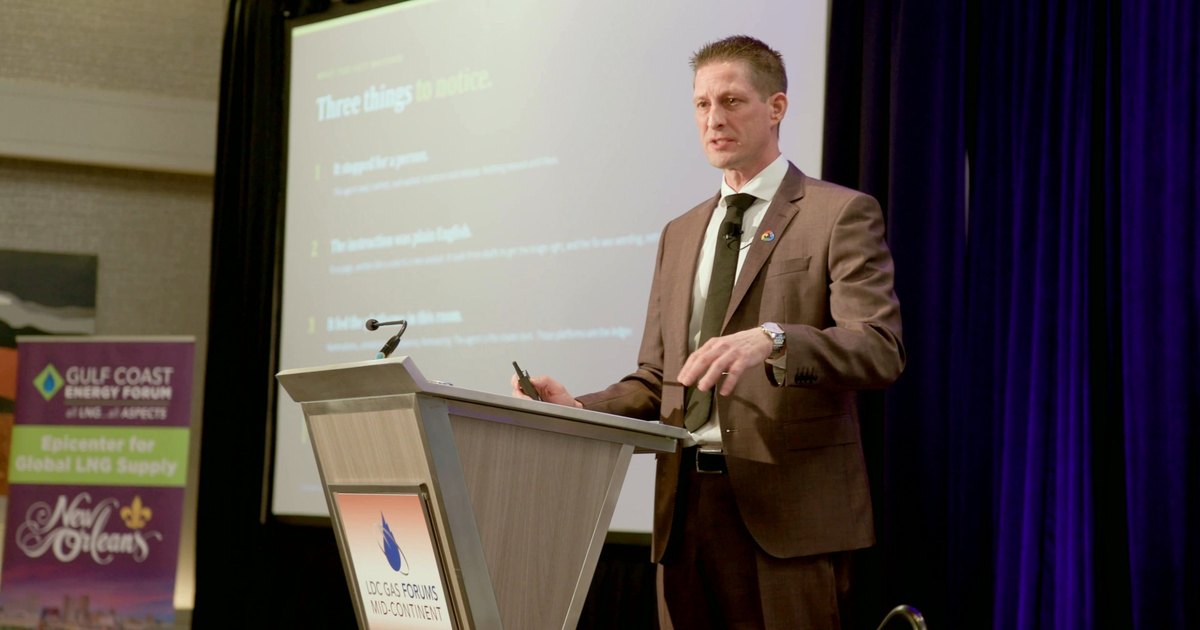
Every AI conversation with a natural gas commercial team lands in the same four places: a short list of things that are clearly working, a longer list of challenges, a few things that are not working and will not, and a real opportunity that most organizations have not yet organized themselves to take. On Tuesday, September 15, I brought those four to the technology panel at the 38th Annual LDC Gas Forum Mid-Continent in Chicago, "Technology. Not A Threat. An Opportunity." This post began as my working notes ahead of the room, and the section below reports back from the stage.
In the news. This panel announcement also ran on AP News, the National Law Review, and more than 55 local news sites nationwide, including WGN 9 Chicago, WFLA Tampa, WCIA Champaign, WGNO New Orleans, KIAH Houston, and KDVR Denver.
From the Stage in Chicago
The panel ran on Tuesday, September 15, at the Westin River North. I used my time on stage to walk the room through building an agent, with a working example I had built the week before: a FERC notice watch that reads every new gas notice on the day it publishes, flags the filings that touch a desk's pipelines, drafts a short brief, and then stops until a person replies. The agent was never the point. The point is that it works with the nominations, scheduling, ETRM, and forecasting platforms a desk already runs rather than replacing any of them, and four of the companies that build those platforms were on the same stage. The free courses and the roadmap below are what I left the room with. Next on the calendar is the Gulf Coast Energy Forum in New Orleans, October 14 through 16.
What the Chicago Panel Is For
The panel title says it plainly: leveraging innovative technology solutions to seize opportunities and overcome challenges. Cleve Hogarth of Cleveland Advisory moderates five of us who build or deploy technology across the natural gas commercial value chain, and the brief asks for practical methods rather than a product tour. Four questions organize the discussion: what is working, what is a challenge, what is not working, and how an organization actually leverages the opportunity.
My seat on the panel is a little different. My co-panelists lead software and technology companies serving the natural gas industry. I run an agency that works across power generation, natural gas, electric utilities, and renewables, which means I get to see what is working and what is failing next door before it reaches gas. What follows is written for the gas room, with that wider view where it is useful. No client is named and no result is quoted. The patterns are the point.
What Is Working With AI in Energy Right Now
The applications that are producing results share a shape: the input is language or pattern, the output is a first pass, and a qualified person checks it before it moves. Where that shape holds, AI is working today, in natural gas and in every neighboring sector.
- Intelligence briefs. Market, regulatory, and competitive monitoring turned into a daily or weekly brief. For a gas desk that is the storage report, weather, basis, pipeline notices, and the overnight news across the basins you buy from. For an LDC it adds commission dockets and rate cases. For a midstream operator it adds FERC filings on the systems you and your competitors run. Electric utilities and renewables developers run the identical workflow against their own sources, and they started earlier. The sources differ. The workflow is the same.
- First-pass document work. Contracts, RFP responses, specifications, bid packages, and proposals drafted from an approved library and a playbook of preferred terms, then reviewed by the people who own them. This is the single most common win we see, in gas and everywhere else.
- Low-code and no-code agents for repeatable operational tasks. Scheduled AI agents that monitor a source, summarize what changed, route it to the right person, and file it. Document classification, meeting notes turned into action logs, invoice and filing intake. Increasingly these are built by the analyst or coordinator who owns the process, on a low-code platform, in an afternoon. Not glamorous, and exactly where hours come back first.
- Stakeholder and customer communication drafts. Rate case explainers, service interruption and restoration updates, community notices for a pipeline or storage project, investor and board updates. AI produces the plain-English first draft in minutes. Communications and legal still approve every word.
- Data cleanup and reporting. Turning spreadsheets, PDFs, and scanned records into structured data, then into the dashboards and regulatory reports that used to consume analyst weeks each quarter.
- Being found by the people who are researching you. Gas buyers, procurement teams, and counterparties now research vendors and suppliers through search and AI engines before the first call. Organizations that have organized their public information for that behavior are getting into more conversations. Organizations that have not are being left out of shortlists they never knew existed.
What Is a Challenge
None of the challenges we see are about the models. They are about the organizations deploying them, and the natural gas industry shares every one of them with the sectors next door.
- Data readiness. The tool is fine. The data underneath it is inconsistent, siloed, or trapped in PDFs, and every output inherits the mess. This is the number one reason a promising pilot produces an unimpressive result.
- Integration debt. New AI capability that does not connect to the systems of record, so staff end up doing double entry and trust erodes within a quarter.
- Security and confidentiality. Contracts, customer data, and anything adjacent to critical infrastructure belong inside an enterprise deployment behind your firewall, with a written data-handling policy. Most organizations have the concern. Fewer have the policy.
- Accountability in a regulated business. A state commission, FERC, or an auditor does not accept "the model said so." Someone signs, and that person has to understand and be able to defend the reasoning.
- Change management and skills. Teams asked to adopt a new platform every quarter stop adopting anything. The scarce skill is not prompting. It is knowing what a wrong answer looks like in your market.
- Measuring return. Most organizations measure "AI adoption." The organizations that keep funding it measure hours returned and cycle time reduced, per workflow.
- Vendor noise. Every platform in the energy stack now carries an AI label. Separating a real capability from a renamed feature takes time most teams do not have.
What Is Not Working
Some of this is uncomfortable, and it is the part of the panel I expect to be most useful. Gas is not making new mistakes here. It is making the ones power and renewables made a year or two earlier.
- Pilots without owners. A tool proves itself with one team and stops there, because nobody owned the rollout. We see this more than anything else.
- Strategy without a workflow. An AI strategy deck, an AI committee that meets quarterly, and no single process that runs differently on Monday morning.
- Consumer chatbots for confidential work. Staff pasting contract terms, customer records, or operational data into a public tool because nobody gave them a sanctioned one.
- Handing AI the decision. Negotiation positions, nominations and scheduling calls, gas control and safety-critical judgments, compliance sign-off. AI can prepare every one of these. It should decide none of them, and the organizations that have tested that line have pulled back.
- Buying the platform before fixing the data. A six-figure deployment on top of the same broken spreadsheets, producing faster versions of the same wrong numbers.
- Treating it as an IT project. The wins are in commercial, regulatory, communications, and operations workflows. When IT owns the whole program, those teams never get a workflow of their own.
The Low-Code and No-Code Agent Opportunity
The biggest shift in the last twelve months is not a smarter model. It is that building an agent no longer requires a developer. An agent, in plain terms, is a workflow that watches for a trigger, gathers what it needs, reasons over it, takes a defined action, and stops for a person at the point you tell it to. Low-code and no-code platforms now let the person who owns a process build that workflow with a visual builder and a written instruction instead of a software project.
That changes who gets to leverage the opportunity. The gas supply coordinator who knows exactly which pipeline notices matter can build the agent that watches for them. The regulatory analyst who reads every commission docket can build the one that summarizes new filings each morning. The proposal manager can build the intake agent that classifies incoming RFPs against the go/no-go criteria. None of them need to wait for IT's roadmap.
The platforms doing this work today include Make.com, n8n, and Zapier on the automation side; Microsoft Copilot Studio inside the Microsoft 365 environment most LDCs and pipelines already run; and the agent builders now offered directly by OpenAI, Anthropic, and Google. Each has free tiers or free training, and each connects to the systems commercial teams already use: email, spreadsheets, document stores, calendars, and the web.
Three rules keep this from becoming the next shadow-IT problem:
- Sanction the platform. Pick one or two, put them under an enterprise account, and give people permission to build.
- Keep confidential data inside the firewall. Public filings, market data, and your own approved documents are fair game. Contracts and customer records go only where your data policy allows.
- Every agent stops for a person. The agent drafts, flags, and routes. A named owner approves anything that moves downstream.
Five Free Courses to Learn AI
The other half of the opportunity is education, and the best of it costs nothing. Anthropic, Google, Oracle, Harvard, and MIT all publish serious AI instruction free of charge. These five cover the range from a non-technical first course to a hands-on engineering sequence, so a commercial team can pick the right entry point for each person.
| Course | Provider | Best for | Cost |
|---|---|---|---|
| Anthropic Academy: AI Fluency | Anthropic | Anyone. No code. A four-hour course on delegating to AI, describing what you want, judging the output, and staying diligent, plus a short course on human and agent teams. The right first course for a commercial team. | Free |
| Google Prompting Essentials | Google (Google Skills) | Anyone. Under 10 hours on how to write a clear prompt, check the answer, and, by the end, build a simple agent. Free, with a badge on completion. | Free |
| Oracle Agentic AI Foundations Associate (2026) and OCI AI Foundations Associate | Oracle University | Professionals who want a recognized credential on AI and agent fundamentals. Training and the Foundations-level exam are free. | Free |
| CS50's Introduction to Artificial Intelligence with Python | Harvard University (edX) | Technically inclined staff who want to understand how search, optimization, and machine learning actually work. Seven weeks. | Free to audit; optional paid certificate |
| 6.S191 Introduction to Deep Learning | MIT | Engineers and data staff ready for the real thing. The 2026 lectures, slides, and labs are open-sourced under the MIT license. | Free |
Worth a look after those: Elements of AI from the University of Helsinki is a free, no-code introduction with two million learners, OpenAI Academy publishes free self-paced courses through to agents and workflows, IBM SkillsBuild issues free digital credentials, and Microsoft's AI Skills Navigator is the front door to its free AI training. For the agent platforms named above, Make Academy, the n8n and Zapier learning libraries, and the Microsoft Learn path for Copilot Studio are all free as well.
A commercial team that puts two evenings a week into this for a month will know more about AI than most of the vendors pitching it.
How to Leverage the Opportunity
The sequence is the same for an LDC, a marketer, a midstream operator, or a producer, and it is the same one the electric side has been running. What changes is the source list and the check.
- 1. Learn the fundamentals for free first. Two evenings a week for a month, using the courses above. You will negotiate better with every vendor afterward.
- 2. Audit the friction. Before buying anything, measure where the hours actually go. The answer is almost never where the vendor demo pointed.
- 3. Pick three workflows. Each with a language or pattern shape and a natural human check. Not thirty. Three.
- 4. Write the check before you deploy. Decide in advance what a person verifies, against which source, before any output moves downstream. Put it in writing.
- 5. Name one owner per workflow. Not a vendor, not a committee. A person accountable for the output that reaches a decision.
- 6. Build the first one low-code. Let the owner build it on a sanctioned platform. If it needs a developer to start, it is the wrong first workflow.
- 7. Deploy inside ninety days and measure. Hours returned and cycle time, per workflow, in numbers the CFO recognizes.
- 8. Compound. The next three workflows, funded by the first three. Fix the data as you go, not before you start.
Organizations that run this sequence stop talking about AI strategy within two quarters. They talk about which workflow is next.
The Workforce Answer
Every workflow above has a third column: what the person still does. That column is the workforce answer. The job does not disappear. It changes shape. Less time producing the first draft, more time verifying it and deciding what to do about it. That is a hiring and training question for every gas commercial team, and the organizations that treat it that way will not have a talent problem. Domain expertise is worth more in this environment, not less, because knowing what a wrong answer looks like is now the scarce skill.
Why Chicago
The rest of the Mid-Continent agenda treats AI as a demand forecast, and rightly so. The opening keynote from James Pearson of ConocoPhillips asks whether demand will catch production. The market panel takes up AI data center impact directly. The infrastructure panel puts PJM Interconnection, Williams, EQT, Southern Company, and TC Energy on one stage for gas-electric coordination. Nicor Gas President and CEO Wendell Dallas keynotes on building reliable energy for lasting growth. According to the International Energy Agency, natural gas is the largest single source of electricity for U.S. data centers and the largest source of additional supply through 2030, and Chicago is one of the largest data center markets in North America.
Our panel is the one session that treats AI as an operating tool rather than a load forecast. The region powering the AI buildout should be the region deploying it.
The Chicago Panel: Details
"Technology. Not A Threat. An Opportunity: Leveraging innovative technology solutions to seize opportunities and overcome challenges" runs Tuesday, September 15, 2026, from 1:45 to 3:15 PM Central Time at the Westin River North, as part of the 38th Annual LDC Gas Forum Mid-Continent, September 14 to 16. Cleve Hogarth, Principal of Cleveland Advisory, moderates. The panel: Jay Bhatty, CEO of NatGasHub.com; Tom Quinn, General Manager of PowerGEM; Scott Vogan, SVP of Sales and Marketing at nGenue; Dhruv Venkatraman of Trellis Energy Software; and Jason Langella, Founder and Chairman of SEO Agency USA.
My co-panelists lead software and technology companies serving natural gas. I run an agency that works across power, gas, electric utilities, and renewables, and my seat is about what it takes to put any of this to work, informed by what the sectors next door have already learned.
Meet SEO Agency USA at LDC Gas Forum Mid-Continent
SEO Agency USA is an official sponsor of the 2026 LDC Gas Forums. The firm engineers organic visibility, AI search positioning, and generative engine optimization for enterprise organizations across energy and critical infrastructure, and builds and implements the AI agents and workflows described above for their commercial teams. If you are in Chicago, connect with the team at the Forum. If you are not, the free GEO Grader shows how search and AI engines describe your organization today.
For a natural gas commercial team, the first build is a regulatory desk agent that reads FERC dockets, state commission filings, and Federal Register notices, drafts the morning brief, flags anything touching company assets, and routes it to a named owner before it reaches the ETRM or contract queue. SEO Agency USA builds these through AI agent development and AI workflow automation on the platforms the client already runs and sanctions, with a person approving every output that moves downstream. An AI strategy and readiness assessment sets the first candidate.
About the Author
Jason Langella is the Founder and Chairman of SEO Agency USA and a recurring voice on technology and AI in the energy sector. He was named the 2025 Associate Member of the Year by the Florida Municipal Electric Association (FMEA) and has taken part in more than 100 energy and utility industry events. Across the 2026 LDC Gas Forums series, he has joined the technology and AI panels at the Southeast Forum in Ponte Vedra Beach, the Northeast Forum in Boston, the Rockies & West Forum in San Diego, and the Mid-Continent Forum in Chicago. Connect with Jason on LinkedIn.
Frequently Asked Questions
What is working with AI in the energy industry right now?
Intelligence briefs from market and regulatory sources, first-pass document work such as contracts and RFP responses, AI agents for repeatable operational tasks, stakeholder communication drafts, and data cleanup and reporting. Each pairs an AI first pass with a defined human check. The pattern holds across the natural gas value chain and across the wider energy industry.
What are the biggest challenges of AI in oil and gas and utilities?
Data readiness, integration with systems of record, security and confidentiality, accountability in a regulated business, change management, measuring return, and separating real capability from vendor noise. None of them are about the models. They are about the organizations deploying them.
What AI use cases in the energy sector should a company start with?
Start with three workflows that have a language or pattern shape and a natural human check: a monitoring brief, a first-pass document workflow, and one repeatable operational task. Write the check, name an owner for each, deploy inside ninety days, and measure hours returned.
Will AI replace jobs in the energy industry?
No. It changes their shape. Less time goes to producing the first draft and more to verifying it and deciding what to do about it. Domain expertise becomes more valuable, because knowing what a wrong answer looks like in your market is the scarce skill.
What is a no-code AI agent?
A workflow that watches for a trigger, gathers what it needs, reasons over it, takes a defined action, and stops for a person at the point you specify, built on a visual platform such as Make.com, n8n, Zapier, or Microsoft Copilot Studio rather than in code. The person who owns the process can usually build the first one in an afternoon.
What are the best free AI courses for energy professionals?
Anthropic Academy's AI Fluency course for a non-technical start, Google's Prompting Essentials on Google Skills, Oracle's free Agentic AI Foundations and OCI AI Foundations training and certification, Harvard's CS50 Introduction to AI with Python for technically inclined staff, and MIT's 6.S191 Introduction to Deep Learning for engineers. All five are free.
When and where is the LDC Gas Forum Mid-Continent technology panel?
Tuesday, September 15, 2026, from 1:45 to 3:15 PM Central Time at the Westin River North in Chicago, as part of the 38th Annual LDC Gas Forum Mid-Continent, September 14 to 16, 2026.
Stop Focusing on Yesterday's Search
See how your brand appears in the new AI Search Funnel. Our free GEO AI Grader reveals if ChatGPT, Perplexity, and Google AI Overviews can find and recommend your brand. Top-of-funnel visibility starts here.