Construction marketing is the work of getting a contractor known, trusted, and invited to bid by the owners, engineers, and general contractors who buy its kind of work. For commercial, industrial, and civil firms, that means proof more than promotion: project history, safety records, prequalification status, and a team an owner can vet before the first call.
Most guides on this topic are written for home builders and trades, where a homeowner searches "near me," reads reviews, and calls. Commercial work runs differently. A capital project team, a facility manager, or a GC's preconstruction group builds a short list, checks each firm's qualifications, and invites only the firms that pass. This guide covers how that process works and what to build so your firm belongs on the list.
Key takeaways
- Commercial buyers shortlist before they call. Owners and GCs check qualifications, safety, and past projects before a contractor hears about the job.
- Proof beats promotion. Project sheets, a safety and prequalification page, and capability pages by project type do more work than ads or slogans.
- Prequalification platforms are part of your marketing. ISNetworld, Avetta, and owner portals are where many hiring clients first see your company's data.
- Search and AI answers draw on the same pages. Google's AI features use the same index as regular Search, so clear, factual capability pages count twice.
- Measure the steps before award. Prequalification approvals, RFQ invitations, and short lists show whether marketing is working long before a contract is signed.
What Is Construction Marketing?
Construction marketing is everything a contractor does to be found, trusted, and invited to bid: its website, project portfolio, safety and qualification documents, directory and plan-room listings, relationships, and reputation with owners and partners. In commercial construction, its job is to put the firm on the short list for the projects it wants.
The buyer is the difference. Residential marketing reaches homeowners, who often decide on reviews and price. Commercial, industrial, and civil marketing reaches:
- Owners and developers, including capital project, facilities, and procurement teams at utilities, manufacturers, hospitals, schools, and public agencies
- Engineers and architects, who write the specifications and often recommend contractors
- General contractors and construction managers, who hire specialty subcontractors
- Design-build and EPC teams, assembling partners for a pursuit
These buyers carry real risk on every award, so they look for evidence first. Referrals still matter, but a referral now ends with the same step: someone opens your website, checks your qualifications, and decides whether you belong on the list.
It is a large market that has cooled. The U.S. Census Bureau estimated construction spending at a seasonally adjusted annual rate of $2,186.1 billion in September 2026, 2.7 percent below September 2025 (U.S. Census Bureau, November 2, 2026). When spending slows, being easy to vet matters more.
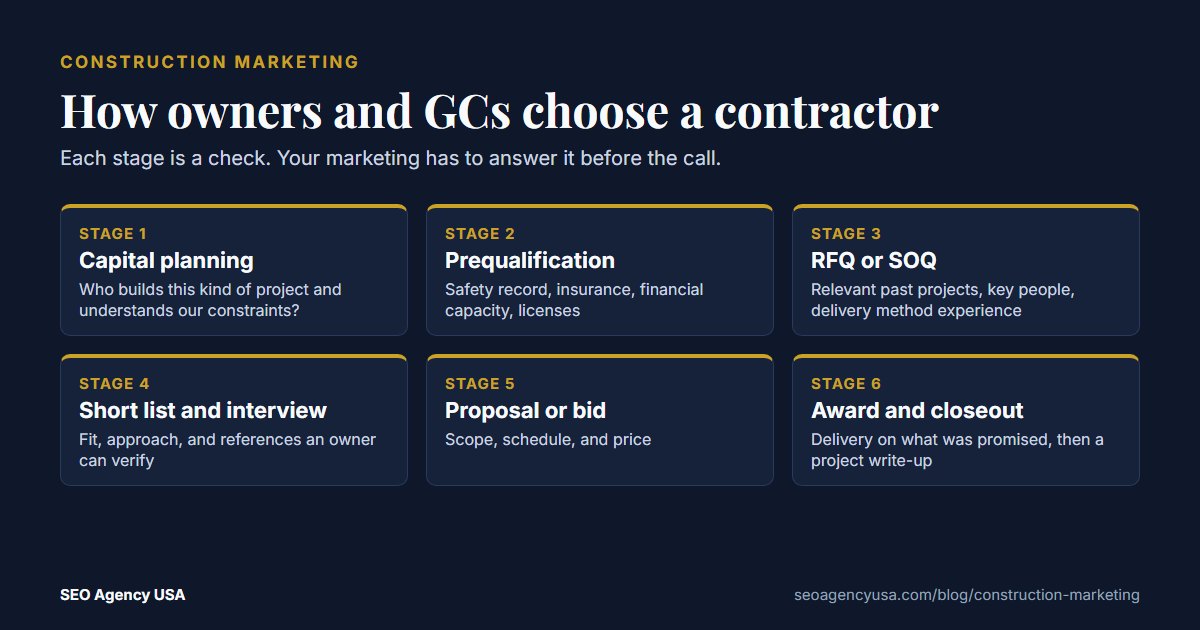
How Owners and GCs Choose a Contractor
Commercial and public owners rarely pick a contractor from a single search. They move through a sequence, and each step asks a question your marketing has to answer.
| Stage | What the buyer checks | What answers it |
|---|---|---|
| Capital planning | Who builds this kind of project and understands our constraints | Capability pages, technical articles, talks at owner events |
| Prequalification | Safety record, insurance, financial capacity, licenses | A safety and prequalification page, current platform profiles |
| RFQ or SOQ | Relevant past projects, key people, delivery method experience | Project sheets, team pages, a ready statement of qualifications |
| Short list and interview | Fit, approach, and references | Project details an owner can verify, consistent company facts |
| Proposal or bid | Scope, schedule, and price | Your estimating and proposal team |
| Award and closeout | Delivery on what was promised | A finished-project write-up, with the owner's permission |
Two parts of this sequence deserve more attention than they usually get.
Delivery method shapes the pitch. The Design-Build Institute of America describes design-build as a single contract for both design and construction, while other delivery methods keep separate contracts for each (DBIA, read November 2026). A firm that wants design-build or EPC work needs pages that show it can carry design and construction together, not only build to someone else's drawings.
Safety numbers can screen a firm out before anyone reads its website. The National Council on Compensation Insurance (NCCI) has written that in some states, contractors with an experience modification rate (E-mod) above 1.00 may be ineligible for the job they are bidding on. NCCI also argues that E-mods are a poor way to compare contractor safety, for reasons that include company size and deductible choices (NCCI, September 5, 2017). Either way, owners keep asking for the number, so explain your safety program in plain terms next to whatever figures the owner requires.
The same goes for prequalification platforms. ISN says more than 900 hiring clients use ISNetworld, which collects and reviews company health, safety, sustainability, insurance, financial, and training information (ISN, read November 2026). Avetta offers company prequalification and subcontractor compliance tools and says more than 360,000 businesses use it (Avetta, read November 2026). For many industrial and utility owners, that profile is their first view of your company. Treat it as a marketing asset: complete, current, and consistent with your website.
Construction Marketing Strategy: What Commercial Buyers Look For
A construction marketing strategy for commercial firms starts with what buyers check and works outward. These eight parts cover most of it.
1. Capability pages by project type and delivery method
Build one page for each project type you want more of, such as substations, water treatment plants, tilt-up warehouses, or hospital renovations. Name the delivery methods you use, the owner types you serve, and the scopes you self-perform. A single "Services" page that lists everything gives an owner, and a search engine, little to go on.
2. Project sheets
For each finished project you can share, list the owner type, location, scope, delivery method, your role, and one or two photos. Get the owner's permission before naming them. Project sheets do double duty: they feed your statement of qualifications, and they give search engines and AI assistants specific facts about your work.
3. A safety and prequalification page
Explain your safety program, your training, and the prequalification platforms you maintain. Publish the safety figures you are comfortable sharing and keep them current. Owners and GCs look for this page during prequalification, and a missing one raises questions you are not there to answer.
4. Team pages that match your SOQ
Owners evaluate people as much as companies. Short bios for project executives, project managers, superintendents, and safety leads, with licenses and certifications, let an evaluator check the team before the interview.
5. Consistent company facts everywhere
Your legal name, address, licenses, NAICS codes, service area, and capabilities should match across your website, Google Business Profile, LinkedIn, project-lead services such as Dodge Construction Network and ConstructConnect, and your prequalification profiles. Mismatches create doubt, for people and for the systems that summarize your company.
6. Associations and industry presence
Committee work in groups such as the Associated General Contractors of America (AGC), Associated Builders and Contractors (ABC), the Design-Build Institute of America (DBIA), or the Construction Management Association of America (CMAA) puts your people in rooms with owners and partners. Show up at your owners' industry events too. A utility's capital projects team spends its conference time at utility events, not contractor trade shows.
7. Construction content marketing that answers owner questions
Construction content marketing works when it answers the questions owners ask before they hire: how a delivery method changes schedule risk, what a site needs before mobilization, how your crews work around an outage window or a running plant. Write for the owner's engineer, not for other contractors. This is also the kind of content AI assistants quote.
8. Construction social media marketing as jobsite proof
For commercial firms, LinkedIn is the natural home for project milestones, safety recognition, new hires, and owner-approved completions. Short jobsite videos and photos show work in progress in a way a brochure cannot. Keep every post consistent with what your website and SOQ say.
Digital Marketing for Construction Companies: Search, AI Answers, and Ads
Digital marketing for construction companies covers three channels that work together: search, AI assistants, and paid media.
Search. Owners and engineers search for project types, capabilities, and regions, such as "design-build water treatment contractor" or "substation construction contractor Southeast." Capability pages and project sheets are what match those searches; a homepage alone rarely does. To see how this works for contractors and GCs, read how our team approaches construction SEO and GEO.
AI answers. Owners and engineers can now ask ChatGPT, Gemini, or Google's AI features to suggest contractors or explain a delivery method. Google says there are no additional requirements to appear in AI Overviews or AI Mode, and that a page must be indexed and eligible to show a snippet to appear as a supporting link. Google also says both features may use a "query fan-out" technique, running several related searches across subtopics to build one response (Google Search Central, read November 2026). That rewards what commercial buyers already want: a specific, factual page for each capability, project type, and region you serve.
Paid media. Paid search fits when people search for exactly what you do, in the places you work. Broad construction terms draw searchers you cannot serve. LinkedIn ads can reach owner-side job titles at named companies during a pursuit, and retargeting keeps your firm in view through long bid cycles. None of it replaces the proof pages above: an ad that lands on a thin website wastes the click.
How to Build a Construction Marketing Plan
A construction marketing plan turns the strategy into a short list of work your team can finish. Here is how to market a construction company in commercial and industrial sectors, step by step.
- Choose the work you want more of. Name the project types, owner types, delivery methods, and regions. Everything else follows from this list.
- See what an owner sees. Search your company name, your top project types, and your region. Ask an AI assistant who builds that kind of project near you. Open your prequalification profiles. Note every gap and every fact that does not match.
- Close the proof gaps first. Capability pages, project sheets, the safety and prequalification page, and team bios come before blogs, ads, or a redesign.
- Publish where your buyers already look. Your website, prequalification profiles, plan-room listings, LinkedIn, and the owner-side events and associations in your sectors.
- Keep it current. Add new projects, safety updates, certifications, and people as they happen. Stale pages read as a stale company.
- Measure the steps before award. Track prequalification approvals, RFQ and bid invitations, short lists, and inquiries by source, alongside search impressions and website inquiries.
Marketing by Contractor Type
What to publish first depends on who buys from you.
| Contractor type | Who buys | What they check first | Publish first |
|---|---|---|---|
| General contractors and construction managers | Owners, developers, institutions | Similar completed projects, delivery method experience, team | Project sheets by market sector, team pages |
| Design-build and EPC firms | Owners with complex or schedule-driven projects | Ability to carry design and construction together, engineering depth | Delivery method pages, integrated project write-ups |
| Specialty subcontractors | GCs and CMs, sometimes owners directly | Safety, capacity, prequalification status, scope fit | Scope pages, safety and prequalification page |
| Heavy civil and public works | Public agencies, DOTs, utilities | Prequalification, past public work, compliance | Public project history, certifications, safety page |
Marketing for General Contractors
Marketing for general contractors leans on the breadth of completed work in each market sector. Owners and developers shortlist a general contractor on similar completed projects, delivery method experience, and the team that will run the job, so project sheets grouped by market sector and team pages that match the firm's SOQ come first. Safety records and prequalification status belong on the site as well, because owners and construction managers check them before they send an invitation to bid.
Commercial construction marketing for specialty firms leans on scope and safety. In both cases the owner's industry matters. Work for utility and energy owners is judged differently from work for industrial and manufacturing owners or data center developers, and the engineers who write the specifications deserve their own attention (see marketing for engineering firms).
Construction Marketing Ideas for Commercial Firms
Many construction marketing ideas online come from home building: contests, yard signs, and real estate agent referrals. These fit commercial and industrial firms better:
- Turn each finished project into a one-page project sheet as soon as the owner approves it, while photos and details are fresh.
- Write owner-facing explainers on the questions your estimators and project managers answer most often.
- Publish safety milestones and training in terms an owner's safety team will recognize.
- Follow up on every trade show and owner event with a short note and a link to the relevant capability page.
- Enter finished projects for industry awards, then add any recognition to the project sheet.
- Clean up plan-room and directory profiles so they match your website.
- Present at your owners' industry events, not only construction events.
- Ask satisfied owners and GC partners for permission to name them as references.
The Bottom Line
- Construction marketing for commercial, industrial, and civil firms is about earning a place on the short list.
- Owners and GCs check qualifications, safety, and past projects before they call.
- Capability pages, project sheets, a safety and prequalification page, and team pages carry most of the load.
- Search and AI assistants draw on the same pages, so specific, factual content serves both.
- Measure prequalification approvals, invitations, and short lists, not only traffic.
For a second look at what owners see when they check your firm, talk to our team.
About the Author
Jason Langella is the Founder and Chairman of SEO Agency USA. He was named the 2025 Associate Member of the Year by the Florida Municipal Electric Association (FMEA) and has taken part in more than 100 energy and utility industry events, where owners, engineers, and contractors meet.
Frequently Asked Questions
What is marketing in construction?
Marketing in construction is everything a contractor does to be found, trusted, and invited to bid, including its website, project portfolio, safety and prequalification documents, directory listings, relationships, and reputation. For commercial and industrial firms, the goal is a place on the short list owners and general contractors build before they award work.
What is the best marketing strategy for a construction company?
For commercial and industrial contractors, the strongest strategy starts with proof: capability pages for each project type, project sheets shared with the owner's permission, a safety and prequalification page, and team bios that match the statement of qualifications. Search, social media, and advertising work best once those pages exist.
How do construction companies get commercial clients?
Commercial clients usually come through prequalification, requests for qualifications, invitations to bid, and relationships with owners, engineers, and general contractors. Contractors put themselves in position by keeping prequalification profiles current, publishing project history and safety information, and showing up where owners in their sectors gather.
How is B2B construction marketing different from residential marketing?
Residential marketing reaches homeowners, who often decide on reviews, price, and local search results. B2B construction marketing reaches owners, engineers, and general contractors, who check safety records, prequalification status, delivery method experience, and past projects before inviting a firm to bid.
Does a construction company need a marketing agency?
Not always. Many firms handle relationships and proposals in-house and bring in outside help for search, AI visibility, and website work. If that is the gap, see our construction marketing services.