Large load interconnection is the process a very large electricity customer, most often a data center, follows to connect to the transmission grid: the request, the utility and grid operator studies, the upgrades those studies call for, the agreements, and energization. In 2026 the rules for that process changed in every major U.S. grid market at once, after the Federal Energy Regulatory Commission (FERC) ordered six grid operators to show their tariffs could handle large loads.
This guide compares the current rules at five of them, ERCOT, PJM, MISO, ISO-NE, and CAISO, in plain English. Every rule links to the grid operator's, the state commission's, or FERC's own document, and the status of each is stated as of November 27, 2026. Most of these rules are still moving, so check the linked source before acting on any of them.
Key takeaways
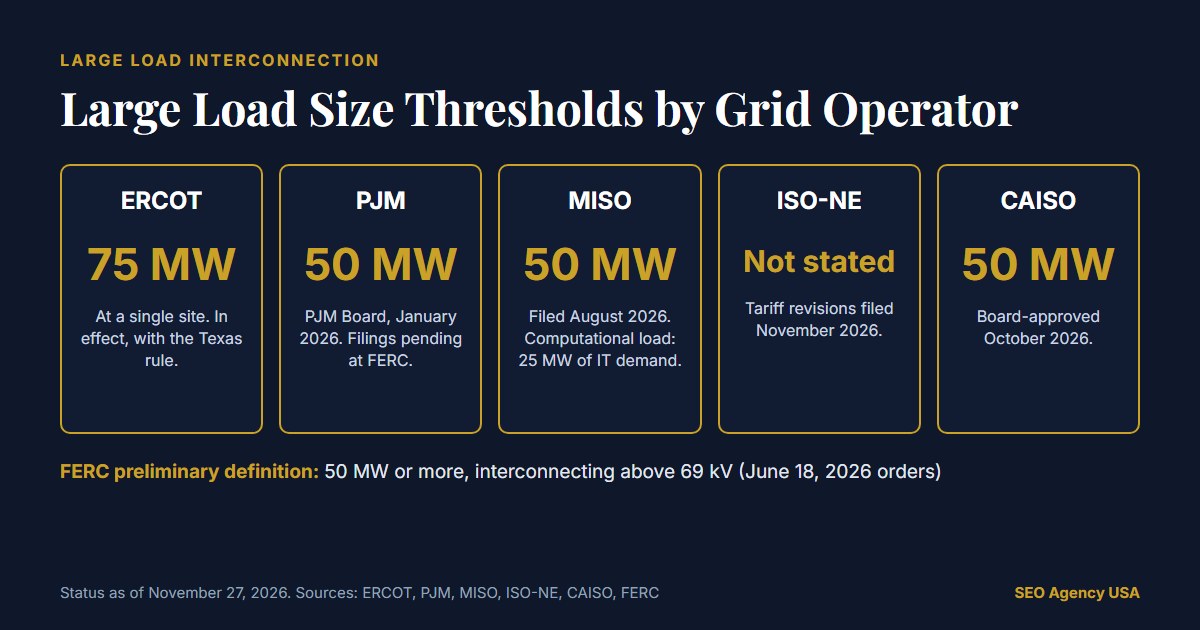
- Most markets now draw the line at 50 MW. FERC's preliminary definition, PJM's board, MISO's filing, and CAISO's proposal all use 50 MW; ERCOT and Texas use 75 MW.
- FERC set the pace. Its June 18, 2026 show-cause orders asked six grid operators to add or justify large load study procedures, and it suggested studies take no more than 60 to 90 days.
- ERCOT studies large loads in batches. Its first batch study, Batch Zero, provisionally classified 204 projects totaling 66.4 GW as base load in September 2026.
- Flexible and interim service is spreading. CAISO's interim service, PJM's connect-and-manage concept, and ERCOT's controllable load pathway all trade faster connection for curtailment.
- On-site generation is now written into the rules. Texas requires disclosure of backup generation, ERCOT has a pathway for customers that build their own power, and PJM offers a "bring your own new generation" option.
What Is Large Load Interconnection?
A large load connects at transmission voltage because the distribution system cannot serve it. RMI's explainer on large load interconnection (April 2026) notes that loads over about 20 MW typically connect at the transmission level. It lays out the steps in order:
- A preliminary inquiry and scoping
- The interconnection request
- Feasibility, system impact, and facilities studies
- An interconnection agreement
- Engineering, permitting, construction, and energization
RMI says the full process "can take anywhere from several months to several years."
Who files depends on the market. In most regions the customer works through its local utility or transmission owner, which carries the request to the grid operator. The utility and grid operator then decide what the grid can serve, what upgrades are needed, and who pays for them.
How Does NERC Define Large Loads?
NERC, the reliability organization for the North American grid, defines a large load by its effect on the grid rather than a megawatt figure. Its September 2025 Level 2 alert describes "any commercial or industrial individual load facility or aggregation of load facilities at a single site" that can pose reliability risks to the bulk power system.
For data centers, NERC is moving to a number. Its third-quarter 2026 large loads update says NERC raised its proposed registration threshold to 50 MW of aggregated computational load at 100 kV and above. On October 8, 2026, its Board approved rule revisions creating two new registered entities, Computational Load Owner and Computational Load Operator. Those criteria still need FERC approval.
Why the Rules Changed in 2025 and 2026
- October 23, 2025: the Secretary of Energy sent FERC an advance notice of proposed rulemaking on the interconnection of large loads to the interstate transmission system (FERC Docket RM26-4-000).
- June 18, 2026: instead of a single national rule, FERC issued show-cause orders to six grid operators: PJM, MISO, SPP, CAISO, ISO-NE, and NYISO. In the PJM order (Docket EL26-67-000), FERC's preliminary definition of a large load is a single site with peak load of 50 MW or greater that interconnects above 69 kV. The order also points to a study deadline of "no more than 60-90 calendar days."
- August to November 2026: FERC paused the deadlines so operators could file their own changes. PJM, ISO-NE, and CAISO filed tariff changes in mid-November 2026; MISO filed reliability requirements in August.
The five markets below are each at a different point in that process.
Large Load Interconnection Rules Compared
Status as of November 27, 2026. "Proposed" means filed or approved by the grid operator's board but not yet accepted by FERC.
| ERCOT (Texas) | PJM | MISO | ISO-NE | CAISO | |
|---|---|---|---|---|---|
| Size threshold | 75 MW or more at a single site | 50 MW or more at a single point of interconnection (PJM Board, January 2026) | 50 MW or more; computational load = 25 MW or more of IT demand (filed August 2026) | Not stated on ISO-NE's project page | 50 MW or more on the ISO-controlled grid (Board-approved October 2026) |
| Who files | Customer to its transmission service provider, which notifies ERCOT | Load-serving entity or network customer through a transmission service request | Not detailed in MISO's filing summary | Not detailed on ISO-NE's project page | Customer to the participating transmission owner under the local utility tariff |
| Study approach | Batch study (Batch Zero), plus a Texas rule on security and disclosure | No dedicated large-load study in today's tariff; a 12-month combined process proposed | Existing expedited tools for generation and transmission; reliability requirements filed | Tariff revisions filed November 13, 2026 | Utility studies load; CAISO reviews related transmission additions monthly |
| Flexible or interim option | Provisional Controllable Load Resource pathway | Connect and manage (under discussion); bring your own new generation | Flexible large load service listed among MISO's planned changes | Resource adequacy rules expected in 2027 | Flexible Interim Load Interconnection service |
| Status | In effect; Batch Zero timeline being reset | Filings pending at FERC | Filing pending at FERC | Filing pending at FERC | Board-approved; tariff amendment listed for filing November 16, 2026 |
ERCOT Large Load Interconnection
ERCOT, which runs most of the Texas grid, treats any site with peak demand of 75 MW or more as a large load. Under its large load interconnection process, a customer submits a request to its transmission service provider (TSP), which studies the load and notifies ERCOT.
Batch Zero. In June 2026 ERCOT replaced one-at-a-time studies with a batch process, and calls itself "the first Independent System Operator (ISO) in the nation" to do so (ERCOT, June 2026). Batch Zero is the first group. ERCOT's September 2026 board update reported that 204 projects totaling 66.4 GW provisionally qualified as base load. ERCOT was still determining the effect on the study timeline, which originally required completion by April 9, 2027. Applications for Batch 1 open in summer 2027.
ERCOT also offers two optional pathways:
- Withdrawal-Limited Private Use Network (WLPUN): for customers that build their own on-site generation, such as natural gas turbines, to offset the transmission capacity they need.
- Provisional Controllable Load Resource (PCLR): for loads that agree ERCOT may curtail them during local constraints.
The Texas rule. The Public Utility Commission of Texas adopted 16 TAC §25.194, its large load interconnection standards under Senate Bill 6, effective October 8, 2026 (PUCT Project 58481). It applies to new interconnections of 75 MW or more. Before an ERCOT study, the customer pays a $100,000 study fee to the utility and posts financial security of $50,000 per MW of requested peak demand. The customer must also disclose site control, other similar requests elsewhere, permits, water use, and on-site backup generation, including its fuel source.
The pause. After Gov. Greg Abbott's August 3, 2026 directive to audit data center projects, ERCOT paused approvals to energize data centers and crypto mining facilities of 75 MW or more. ERCOT's board update says it will file its verification and community impact reports with the PUCT by December 10, 2026.
The natural gas side of this queue is covered in our analysis of natural gas for data centers, including what an AI agent found in ERCOT's monthly reports.
PJM Large Load Interconnection
PJM, the largest U.S. grid operator, has no dedicated large-load study process in its tariff today. FERC's June order put it directly: "PJM's Tariff does not have any specific study provisions or requirements" for customers requesting transmission service for large load additions. Today, new load reaches PJM through a transmission service request or a notice of new network load from the utility or load-serving entity.
PJM's Board set the direction in a January 16, 2026 decision after a fast-track stakeholder process:
- Definition: individual load additions at or above 50 MW at a single point of interconnection.
- Bring your own new generation: a voluntary option for large loads that bring new generation, paired with an expedited interconnection track for that generation.
- Connect and manage: new load without offsetting generation could be asked to move to backup generators or curtail for a limited number of hours a year (still under stakeholder discussion).
- No separate queue: the Board chose not to create a dedicated load interconnection queue.
On November 16, 2026, PJM filed two proposals at FERC: ride-through and operating requirements for large computational loads (Docket ER27-522), and a Fast Energization Process with new transmission services (Docket ER27-531), with requested effective dates in early 2027 (PJM notice of filing). In stakeholder meetings PJM described combining generation, transmission, and large-load studies into one 12-month process. Both filings were pending at FERC as of November 27.
MISO Large Load Interconnection
MISO, which runs the grid across much of the Midwest and parts of the South, filed large load interconnection reliability requirements with FERC on August 28, 2026 (MISO, September 2026). The filing defines:
- Large Load: demand of 50 MW or more.
- Computational Load: a large load with 25 MW or more of demand from IT equipment.
The requirements, including visibility and ride-through, apply to new computational loads that start service after December 4, 2026. Ride-through details are being written into MISO's business practice manuals through its Large Load Working Group.
MISO's January 2026 large load workshop showed why speed matters: a new large load can be built in 1.5 to 3 years, against about 4 years for new generation and 7 to 10 years for new transmission. MISO pointed to two existing expedited tools, the Expedited Resource Addition Study for generation that serves new load and an expedited review for transmission projects. The workshop described a surge in large load requests "primarily from data centers."
ISO-NE Large Load Interconnection
ISO New England's Large Loads Integration project responds to FERC's June 18 show-cause order (Docket EL26-72-000). On November 13, 2026, ISO-NE filed proposed tariff revisions with FERC to address the five categories of reform the order identified. ISO-NE says it expects to file detailed resource adequacy rules for large loads in 2027. ISO-NE's project page does not state a megawatt threshold.
New England has less data center activity than Texas or PJM, so the practical question for suppliers there is how the resource adequacy rules treat new load that brings its own capacity.
CAISO Large Load Interconnection
In California, load interconnection runs through the local utility's tariff, not CAISO's. CAISO's October 2026 decision memo says participating transmission owners primarily manage load interconnection studies and financing, while CAISO reviews the related transmission additions each month to fit FERC's 60 to 90 day study expectation.
The memo proposed:
- A definition: end users with peak load of 50 MW or greater interconnecting to the ISO-controlled grid.
- Flexible Interim Load Interconnection (FILI): a service that lets large loads connect quickly while network upgrades are built, then move to firm service.
- Co-located load and generation studied together; generation that only serves the site needs no CAISO interconnection study.
CAISO's stakeholder page lists Board approval on October 28, 2026, and a tariff amendment (Docket ER27-506) for November 16, 2026.
How Long Does a Large Load Interconnection Study Take?
There is no single answer, and few grid operators publish averages. The figures on the record:
- FERC's expectation: no more than 60 to 90 calendar days per study, in its June 2026 orders (preliminary, not a final rule).
- ERCOT: ERCOT has 10 business days to review a preliminary study report, extendable by 20 more. Batch Zero was originally due for completion by April 9, 2027.
- PJM (proposed): a single 12-month process for generation, transmission, and large-load studies.
- One utility's estimate: American Transmission Company expects planning and studies for a load to take 6 to 18 months, and construction requiring a line extension at least 18 months and as long as 60 months, as cited by Lawrence Berkeley National Laboratory (June 2026).
The study is rarely the longest step. Building the substation and network upgrades usually is, which is why developers look for interim service, flexibility, and on-site power. Our guide to speed to power covers those levers and who supplies each one.
What This Means for Suppliers and Builders
The new rules change who gets work, and when.
- Generator, turbine, engine, and fuel cell makers: on-site power now has a defined place in the rules, from ERCOT's WLPUN pathway to PJM's bring-your-own-generation option and CAISO's co-location treatment. Texas also requires every large load to disclose its backup generation.
- Gas suppliers and pipelines: on-site generation means fuel supply and transportation enter the interconnection conversation early. Our team works with energy and utility companies on how they show that capability.
- Electrical contractors and equipment makers: ride-through and operating requirements in MISO and PJM put power electronics, protection, and controls into the interconnection review.
- Utilities and transmission owners: studies, deadlines, and cost recovery move to the front, with FERC's 60 to 90 day expectation as the benchmark.
- Engineering firms: every market needs more study capacity, from load modeling to ride-through analysis.
- Developers: financial security and disclosure rules, such as Texas's $50,000 per MW, sort serious projects from speculative ones, which raises the value of suppliers who can commit dates.
SEO Agency USA builds the search and AI visibility that helps these companies reach data center developers while the rules are being written. See our data center power and construction marketing page, or contact the team.
What This Guide Does Not Cover
NYISO and SPP also received FERC show-cause orders on June 18, 2026, and are not compared here. Retail large load tariffs set by state commissions and individual utilities also vary widely and are outside this guide's scope.
Frequently Asked Questions
What is a large load?
A large load is a single electricity customer big enough to affect the transmission grid, most often a data center. Definitions vary: FERC's preliminary definition is 50 MW or more at above 69 kV, PJM, MISO, and CAISO use 50 MW, and ERCOT and Texas use 75 MW.
How does NERC define large loads?
NERC defines a large load by its potential effect on the bulk power system rather than its size: any commercial or industrial load at a single site that can pose reliability risks due to its demand or operating characteristics. For computational loads such as data centers, NERC's Board approved registration criteria in October 2026 using 50 MW at 100 kV and above, pending FERC approval.
What is ERCOT Batch Zero?
Batch Zero is the first group of large loads studied together under ERCOT's batch study process, adopted in June 2026 for loads of 75 MW or more. In September 2026, ERCOT reported that 204 projects totaling 66.4 GW provisionally qualified as base load. Applications for the next batch, Batch 1, open in summer 2027.
What is a large load tariff?
A large load tariff is a utility rate class, tariff, or standard contract with terms written for very large customers. Lawrence Berkeley National Laboratory's June 2026 speed-to-power report lists common protections, including minimum contract length, exit fees, minimum billing demand, and collateral and credit requirements, and counts more than 20 states with active large load tariff proceedings in 2025.
How long does an interconnection study take?
It varies by market and utility. FERC's June 2026 orders suggest large load studies take no more than 60 to 90 calendar days, PJM has proposed a 12-month combined process, and one Midwest transmission owner estimates 6 to 18 months for planning and studies. Construction of the required upgrades usually takes longer than the study.