Speed to power is how quickly a new or expanding data center can get reliable electricity: the time from a power request to energized load, including studies, grid upgrades, equipment, and any on-site generation. EPRI puts it plainly: "speed to power has become a critical factor in site selection." For the companies that supply that power and build the infrastructure behind it, speed to power is now a large part of what a developer is buying.
This guide is written for those companies: gas suppliers and pipelines, generator and turbine makers, utilities, electrical and MEP contractors, and engineering firms. It covers why power became the bottleneck, the levers that shorten the wait, who controls each one, and what a developer's site team looks for before it calls.
Key takeaways
- Power sets the pace. Lawrence Berkeley National Laboratory (LBNL) estimates data centers could account for 11.8% of U.S. electricity by 2030, within a scenario range of 9.5% to 15.3%.
- Construction is often the slowest step. LBNL's June 2026 speed-to-power report says the most time-intensive part of a large load connection is often building the interconnection facilities and network upgrades.
- There are four ways to get power. EPRI groups them as grid-connected inflexible, grid-connected flexible, bridge-to-grid, and islanded.
- Every lever has an owner. Utilities run studies and upgrades; gas suppliers, turbine and engine makers, and fuel cell companies supply bridge and on-site power; contractors and equipment makers decide how fast substations and switchgear get built.
- Proof wins the shortlist. Developers compare delivered capacity, energization dates, and equipment slots before they compare proposals.
What Is Speed to Power?
Speed to power describes the time it takes a large electricity user, most often a data center, to go from a request for power to running on it. The U.S. Department of Energy uses the same phrase for a broader program: its Office of Electricity launched the Speed to Power initiative on September 18, 2025, as a federal effort to accelerate large-scale transmission and generation projects (DOE Speed to Power).
For a data center, speed to power has three parts:
- The grid path: load forecasting, the interconnection request, utility and grid operator studies, and the transmission and substation work those studies require.
- The equipment path: transformers, switchgear, breakers, and, for on-site power, turbines, engines, fuel cells, and batteries.
- The fuel and permit path: firm gas supply and transportation for any on-site generation, plus air permits and local approvals.
The slowest of the three sets the energization date. That is why speed to power is a question for every company in the chain, not only for the utility.
Why Speed to Power Became the Bottleneck
Demand rose faster than the grid was built to add it.
- Data center demand. LBNL's 2025 update to its U.S. data center energy report (June 2026) estimates data centers could account for 11.8% of U.S. electricity by 2030, up from a 2028 range of 6.7% to 12.0% in its 2024 report.
- Peak demand forecasts. NERC's 2025 Long-Term Reliability Assessment (January 2026) forecasts summer peak demand across its North American assessment areas rising by more than 224 GW over 10 years, with new data centers accounting for most of the increase. It finds 13 of 23 assessment areas face resource adequacy challenges in that period.
- Requests in the largest markets. In Texas alone, ERCOT told the state Senate in July 2026 that it was tracking about 474 GW of large loads seeking to connect, about 90% of them data centers (ERCOT, figures as of June 2026).
- Equipment. DOE's July 2024 report to Congress on large power transformers says 36-month lead times are commonly quoted, with some reaching 60 months, against less than a year before the pandemic (DOE, Large Power Transformer Resilience).
DOE's own request for information shows the size of the queue it is trying to move. The Office of Electricity received 369 responses and identified 238 projects that, if built, would add 162.9 GW of in-service capacity by 2030 (DOE stakeholder input).
How long does it take? Published figures are scarce and vary by utility. LBNL's report cites one example: American Transmission Company expects planning and studies for a new load to take 6 to 18 months, and construction that requires a line extension to take at least 18 months and as long as 60 months (LBNL, Speed to Power). Rules for each grid operator are compared in our guide to large load interconnection rules by grid operator.
The Four Ways a Data Center Gets Power
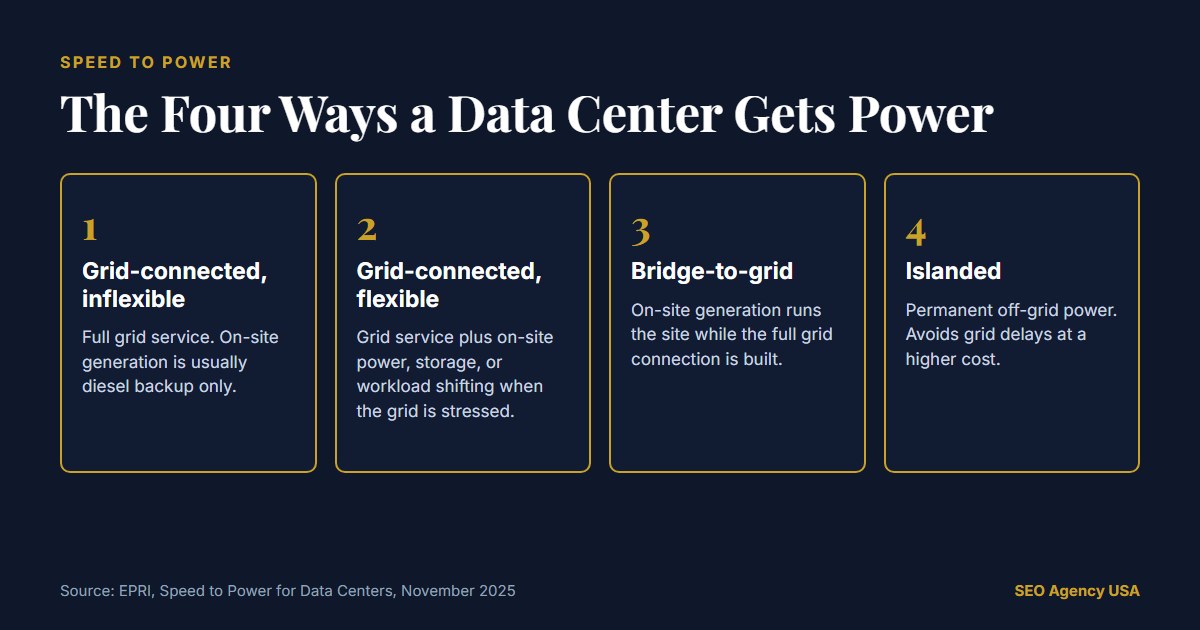
EPRI's Speed to Power for data centers paper (November 2025) groups the options into four strategies:
| Strategy | What it means | Speed to power |
|---|---|---|
| Grid-connected, inflexible | Full grid service; on-site generation is usually diesel backup only | Depends on the grid timeline |
| Grid-connected, flexible | Grid service plus on-site generation, storage, or workload shifting so the site can reduce demand when the grid is stressed | Can connect sooner where the grid has headroom most hours |
| Bridge-to-grid | Temporary or permanent on-site generation while the full grid connection is built | EPRI says this "may be fastest" |
| Islanded | Permanent off-grid power | Avoids grid delays, at what EPRI calls "significantly higher costs" |
Most projects mix these. A campus may start on bridge power, connect to the grid, and keep its on-site plant as a flexible resource. Each choice changes which suppliers and contractors get the work.
The Levers, and Who Controls Each One
| Lever | What it does | Who supplies it | What a developer asks |
|---|---|---|---|
| Interconnection studies and service | Defines what the grid can serve and what upgrades are needed | Utilities, transmission owners, grid operators, consulting engineers | How much capacity, by when, and under what terms? |
| Flexible or interim service | Connects load sooner in exchange for reducing demand at peak | Utilities and grid operators, with the data center's own controls | How many curtailment hours, and what triggers them? |
| Transmission upgrades and reconductoring | Adds capacity on existing corridors | Utilities, line contractors, conductor makers | Is the upgrade funded and scheduled? |
| Substations and switchgear | Steps down and distributes power on site | Electrical contractors, EPC firms, transformer and switchgear makers | Are the transformers ordered, and when do they ship? |
| On-site and bridge generation | Powers the site before or alongside the grid | Turbine and engine makers, fuel cell companies, gas suppliers, pipelines | How many megawatts, how fast, and on what fuel? |
| Batteries | Smooths load swings, adds flexibility, backs up bridge power | Storage integrators, electrical contractors | What duration and response time? |
Three levers deserve a closer look.
Load flexibility. A data center that can cut demand for a small number of hours a year needs less firm grid capacity. A February 2025 Duke University Nicholas Institute study, as reported by Utility Dive, estimated that the 22 largest U.S. balancing authority areas could accommodate 76 GW of new load if it could be curtailed for 0.25% of its maximum uptime, and 126 GW at 1%. EPRI's DCFlex initiative tests the same idea with data center and utility partners at demonstration sites.
Transmission upgrades. Under its SPARK funding round, part of the Speed to Power initiative, DOE announced its intention to help fund 31 grid projects in 26 states with about $1.9 billion in federal funding. The recipients are expected to reconductor or rebuild more than 1,500 miles of transmission lines (DOE SPARK).
Bridge and on-site generation. EPRI defines bridge-to-grid as "using temporary or permanent generation while awaiting full grid connection." Examples on the record include Bloom Energy's fuel cell agreement with Oracle (July 2025), compressed natural gas from Certarus supplying a data center's on-site power until a permanent pipeline connection is ready (September 2025), and large behind-the-meter gas plants such as those in our analysis of natural gas for data centers. Turbine supply is tight: GE Vernova reported 122 GW of gas power backlog and slot reservations in its third-quarter 2026 results (GE Vernova).
What Each Type of Firm Should Show a Developer
A developer's site team, or the AI assistant it asks first, is trying to answer one question: who can get this campus powered, and when? Each type of firm answers it with different proof.
Gas suppliers and pipelines. Firm supply and transportation options by region, lateral and interconnect history, delivery to on-site generation, and how long past projects took from agreement to first gas. Our team works with energy and utility companies on exactly this kind of proof.
Turbine, engine, and fuel cell makers. Available capacity and delivery windows in plain terms, installed data center references, emissions and permitting support, and how units pair with batteries and the grid later.
Utilities. Available capacity by area, large-load tariff terms, the steps and study timelines a customer should expect, and contacts for economic development. Developers compare territories before they compare sites.
Electrical and MEP contractors and EPC firms. Substation, switchgear, and on-site plant projects by size, energization dates against schedule, equipment procurement approach, and safety record. See how we approach construction SEO and marketing for these firms.
Engineering firms. Interconnection studies, protection and controls, power system studies, and permitting support, with the utilities and grid operators the firm works with. Our page on marketing for engineering firms covers that buyer.
Equipment makers. Lead times, factory capacity, and standards compliance stated clearly, since transformers and switchgear can decide the energization date. More on industrial marketing for equipment manufacturers.
Facts like these win more often when they sit on clear, dated pages that a search engine or AI assistant can read, not only in a sales deck.
How Data Center Teams Find Power Partners
Site selection teams search for capacity, partners, and proof long before a request for proposals goes out. They search by market ("power for data centers in Texas"), by method (behind-the-meter, bridge power), and by equipment. Increasingly, they ask an AI assistant to summarize who can deliver.
That research runs on public data. For the NatGas To Power Forum in Austin in November 2026, our Founder and Chairman, Jason Langella, built an AI agent that read ERCOT's interconnection queue, Texas gas turbine air permits, and state large-load rulemakings each month, checked every number against the source, and handed the brief to a person. The Austin write-up shows what it found. He spoke on technology and AI at all six of the 2026 LDC Gas Forums.
SEO Agency USA builds the search and AI visibility that puts the companies behind speed to power in front of those teams. See our data center power and construction marketing page, or contact the team.
The Bottom Line
- Speed to power is the time from a power request to energized load, and the slowest of the grid, equipment, and fuel paths sets it.
- EPRI's four strategies (inflexible, flexible, bridge-to-grid, islanded) decide which suppliers and contractors get the work.
- Utilities, gas suppliers, generator makers, contractors, engineers, and equipment makers each control a lever.
- Developers shortlist the firms whose capacity, dates, and references are easy to verify.
Frequently Asked Questions
What does speed to power mean?
Speed to power is how quickly a data center or other large load can get reliable electricity, from the first power request to energized operation. It includes utility studies, grid upgrades, equipment delivery, and any on-site or bridge generation. EPRI calls it a critical factor in data center site selection.
Does the U.S. have enough electricity for data centers?
Not everywhere on the timelines developers want. NERC's 2025 Long-Term Reliability Assessment forecasts North American summer peak demand rising by more than 224 GW over 10 years, mostly from data centers, and finds 13 of 23 assessment areas face resource adequacy challenges. Capacity depends on the region and on how fast generation, transmission, and equipment can be added.
What is bridge power for a data center?
Bridge power is on-site generation that runs a data center while its full grid connection is being built. EPRI calls this strategy bridge-to-grid and defines it as using temporary or permanent generation while awaiting full grid connection. Gas turbines, reciprocating engines, fuel cells, and batteries are common choices.
Why are transformer lead times so long?
Demand for large power transformers rose faster than factory capacity. DOE's July 2024 report to Congress says 36-month lead times are commonly quoted, with some as long as 60 months, compared with less than a year before the pandemic. New transformer factories take one to three years to build, according to the same report.
How do suppliers prove speed to power?
With facts a developer can check: capacity available by region, past energization dates against schedule, equipment delivery windows, installed data center references, and the utilities and grid operators they have worked with. Publishing those facts on clear, dated pages helps search engines and AI assistants surface them.