A cybersecurity marketing strategy is the plan a security vendor or managed security provider uses to get found, believed, and shortlisted by the people who buy security. Those buyers are trained to distrust claims. They test products, read the documentation, ask peers, and check every statement against a framework they already know. Marketing that works for them looks less like promotion and more like evidence.
This guide covers how cybersecurity buyers decide, what content each person on the buying team needs, how SEO and AI search fit in, and how to measure the work. It is written for B2B security companies: software vendors, managed security and managed detection providers, OT security specialists, and the consultancies that assess and test.
Key takeaways
- Proof beats promotion. Security buyers believe what they can verify: documentation, frameworks named correctly, test results, and references.
- Write for the whole buying team. The CISO, the engineer who runs the proof of concept, the compliance lead, and procurement each need different pages.
- Content marketing is the core channel. Technical guides, comparison pages, and plain answers to buyer questions do most of the work in a long sales cycle.
- AI answers draw on the same pages. Google says AI Overviews and AI Mode have no extra requirements beyond normal SEO, so clear, factual pages count twice.
- Measure pipeline, not traffic. Demo requests, proof-of-concept starts, and opportunities created show whether the strategy is working.
What Is Cybersecurity Marketing?
Cybersecurity marketing is the work of getting a security company known and trusted by the buyers who protect networks, data, and operations. It covers positioning, website and product pages, content marketing, SEO and AI visibility, events, paid search, email, and the materials sales uses in a deal.
What makes it different from other B2B marketing is the audience. Security leaders are paid to find weaknesses, including in vendor claims. A phrase like "stops 100 percent of threats" ends a conversation. A clear explanation of what the product detects, how it was tested, and where it fits in a framework such as the NIST Cybersecurity Framework 2.0 starts one.
Why Cybersecurity Marketing Is Hard
Three things make the job harder than it looks.
The market is crowded and the language is shared. Zero trust, XDR, managed detection and response, and AI-driven detection appear on almost every vendor site. When every company uses the same words, buyers cannot tell them apart, and they fall back on peers and analysts.
The buyer changes depending on the deal. A product sold to a mid-market IT director is evaluated differently from one sold to a utility's OT security team or a federal program office. Federal and defense buyers bring their own requirements, such as FedRAMP authorization for cloud services and CMMC for defense contractors.
Regulation raises the stakes. Under the SEC's 2023 rules, public companies disclose a material cybersecurity incident on Form 8-K within four business days of deciding it is material, and describe their cybersecurity risk management and board oversight each year (SEC). That puts security decisions in front of boards and general counsel, not only the security team. Marketing that speaks to those reviewers, with plain language about risk and governance, reaches people a product sheet never will.
Know the Buying Team
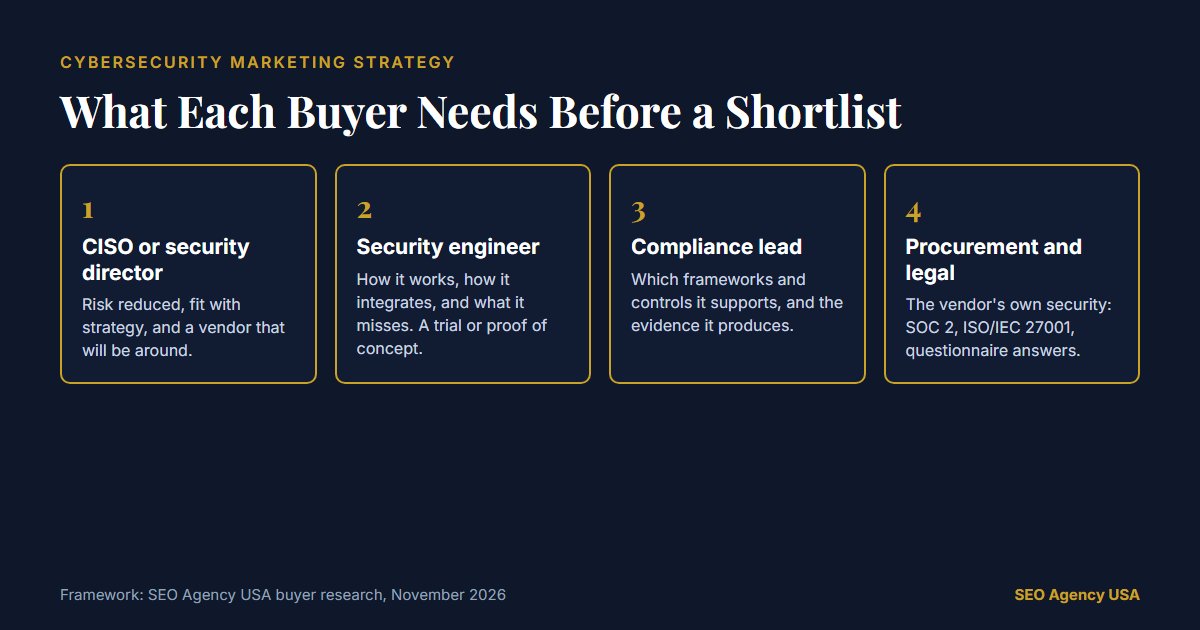
Most security purchases involve several people, and each one has a different question.
| Role | What they need to see | Content that answers it |
|---|---|---|
| CISO or security director | Risk reduced, fit with strategy, vendor stability | Executive briefs, framework mapping, references |
| Security engineer or architect | How it works, how it integrates, what it misses | Technical documentation, architecture pages, trial or proof of concept |
| Compliance or GRC lead | Which requirements it supports and what evidence it produces | Framework and regulation pages, sample reports, audit support details |
| Procurement and legal | Security of the vendor itself, contract terms, certifications | Trust center, SOC 2 report access, security questionnaire answers |
A website that speaks only to the CISO loses the engineer. One that speaks only to engineers gives the executive nothing to forward. The strongest cybersecurity marketing strategies build a path for each role and connect them.
Build the Strategy on Proof
Name the problem precisely
Pick the problems you solve and the buyers who have them, then say so in plain terms. "Managed detection and response for mid-sized manufacturers running OT networks" is a position. "Next-generation security for the modern enterprise" is not.
Show your work
Publish what a careful buyer would ask for anyway: how detection works, what the product does not do, which frameworks and controls it maps to, and how customers deploy it. A trust center with your own certifications, such as a SOC 2 Type II report available under NDA or ISO/IEC 27001 certification, answers procurement before it asks. Software makers can also point to commitments buyers recognize, such as CISA's voluntary Secure by Design pledge, whose goals include multi-factor authentication, removing default passwords, and a vulnerability disclosure policy.
Use frameworks buyers already know
Map products and services to the frameworks your buyers report against: NIST CSF 2.0 and its six functions, NIST SP 800-53 controls, CIS Controls, ISO/IEC 27001, and sector rules such as NERC CIP for the bulk power system. Getting a control number or a standard's scope wrong costs credibility fast, so every reference should be checked against the source.
Earn references
Case studies matter more in security than almost anywhere else, and they are harder to get because customers rarely want their names attached to a security story. Anonymized case studies by industry and environment, with the customer's written approval, still carry weight when they are specific about the problem and the result.
Cybersecurity Content Marketing
Content marketing is the center of most effective cybersecurity marketing strategies because the sales cycle is long and the buyers research on their own. The content that works falls into a few types:
- Problem and framework guides that explain a requirement or threat plainly and show where your product or service fits.
- Comparison and alternative pages that are fair to competitors. Engineers can tell when a comparison is rigged.
- Technical deep dives written or reviewed by your engineers, such as how a detection works or how to deploy in a segmented network.
- Answers to real buyer questions, taken from sales calls, security questionnaires, and support tickets.
- Original research, when you have real data you are allowed to share.
Publishing frequency matters less than accuracy and depth. One well-sourced guide that a security engineer bookmarks does more than ten short posts that repeat what everyone else says.
SEO and AI Visibility for Cybersecurity Companies
Buyers research before they talk to sales, and more of that research now starts with an AI assistant as well as a search engine. Google says there are no additional requirements to appear in AI Overviews or AI Mode beyond normal SEO best practice: a page needs to be indexed and eligible to show a snippet (Google Search Central). The practical result: pages that are clear, specific, and accurate serve both.
For a cybersecurity company, that means:
- A page for each product, service, and buyer problem, each with one clear job
- Plain definitions and direct answers near the top of each page
- Consistent company facts across the website, business profiles, and industry directories
- Structured data that describes the company, its services, and its people
- Regular checks of what AI assistants say when buyers ask who solves a given problem
Our cybersecurity SEO services are built around this work, and our AI visibility and GEO methodology explains how we check and improve the way assistants describe a company.
Cybersecurity Lead Generation
Lead generation in security works best when it respects how the buyer evaluates. Gated whitepapers still have a place, though many engineers will not trade an email for a PDF. Offers that tend to work better:
- A trial, sandbox, or proof of concept for products an engineer can test
- An assessment or readiness review with a defined scope, for services firms
- Interactive tools, such as a framework mapping or a requirements checklist
- Events and webinars where your engineers answer questions live
Route each lead with its technical context, so the first sales conversation starts where the buyer's research ended. Our team builds this routing as part of AI workflow automation, with a person approving every reply.
Cybersecurity Marketing Campaigns That Fit the Buyer
Campaigns work when they follow the buyer's calendar rather than the vendor's. Useful triggers include new regulations and compliance dates, published advisories that affect a buyer's environment, budget cycles, and industry events. A campaign built around a real deadline, such as a new reporting requirement, gives the buyer a reason to act that has nothing to do with your quarter.
Paid search can support the strategy for high-intent terms, though it rarely carries it alone. Keep message match tight: the ad promises one thing, and the landing page delivers exactly that.
How to Measure Cybersecurity Marketing
Traffic and impressions show reach. They do not show whether the strategy is working. Track the steps that lead to revenue:
- Demo requests, trial starts, and proof-of-concept starts
- Opportunities created and their source
- Security questionnaire requests, a strong late-stage signal
- Branded search growth, a sign that buyers heard about you elsewhere
- How often AI assistants name and describe your company correctly for your core problems
Report these monthly, by channel and by buyer type, and cut the work that does not move them.
Where Physical Security Fits
Cameras, access control panels, and building systems now sit on networks, so cybersecurity and physical security often meet at the same devices and sites. If your company also sells to physical security buyers, keep the two programs separate, because those buyers use different words and check different evidence. Our guide to cybersecurity vs physical security explains the difference, our physical security marketing page covers that side, and our guide to lead generation for security companies shows how those buyers specify and bid.
The Bottom Line
- A cybersecurity marketing strategy wins on evidence: precise positioning, documentation, framework mapping, and references.
- Build content for each role on the buying team, from the CISO to procurement.
- Content marketing carries the long sales cycle; SEO and AI visibility put it in front of buyers.
- Use offers that respect how engineers evaluate, and route leads with context.
- Measure pipeline steps, not only traffic.
To see how buyers and AI assistants describe your company today, talk to our team.
About the Author
Jason Langella is the Founder and Chairman of SEO Agency USA. He was named the 2025 Associate Member of the Year by the Florida Municipal Electric Association (FMEA) and has taken part in more than 100 energy and utility industry events, where owners, engineers, and contractors meet.
Frequently Asked Questions
What is a cybersecurity marketing strategy?
A cybersecurity marketing strategy is the plan a security company uses to get found, believed, and shortlisted by security buyers. It defines who the company serves, what proof it publishes, which content it creates for each role on the buying team, and how it measures pipeline. For security buyers, evidence such as documentation, framework mapping, and references matters more than promotional claims.
How do you market a cybersecurity company?
Start with a precise position: the problems you solve and the buyers who have them. Then publish the evidence a careful buyer would ask for, build content for the CISO, engineers, compliance, and procurement, and make that content easy to find in search and AI answers. Offer trials, assessments, or tools instead of relying only on gated PDFs.
What content works best for cybersecurity marketing?
Plain guides to frameworks and threats, technical deep dives reviewed by your engineers, fair comparison pages, answers to real buyer questions from sales calls and security questionnaires, and specific case studies approved by customers. Accuracy and depth matter more than publishing volume.
How do cybersecurity companies generate leads?
The most reliable offers are trials or proofs of concept for products, scoped assessments for services firms, interactive tools such as framework checklists, and live technical events. Each lead should reach sales with its research context, so the first conversation continues where the buyer left off.
Do cybersecurity companies need SEO?
Yes. Security buyers research on their own before they contact a vendor, in search engines and increasingly in AI assistants. Google says AI Overviews and AI Mode have no extra requirements beyond normal SEO, so clear, accurate, well-structured pages help a company show up in both. See our cybersecurity SEO services for how we approach it.