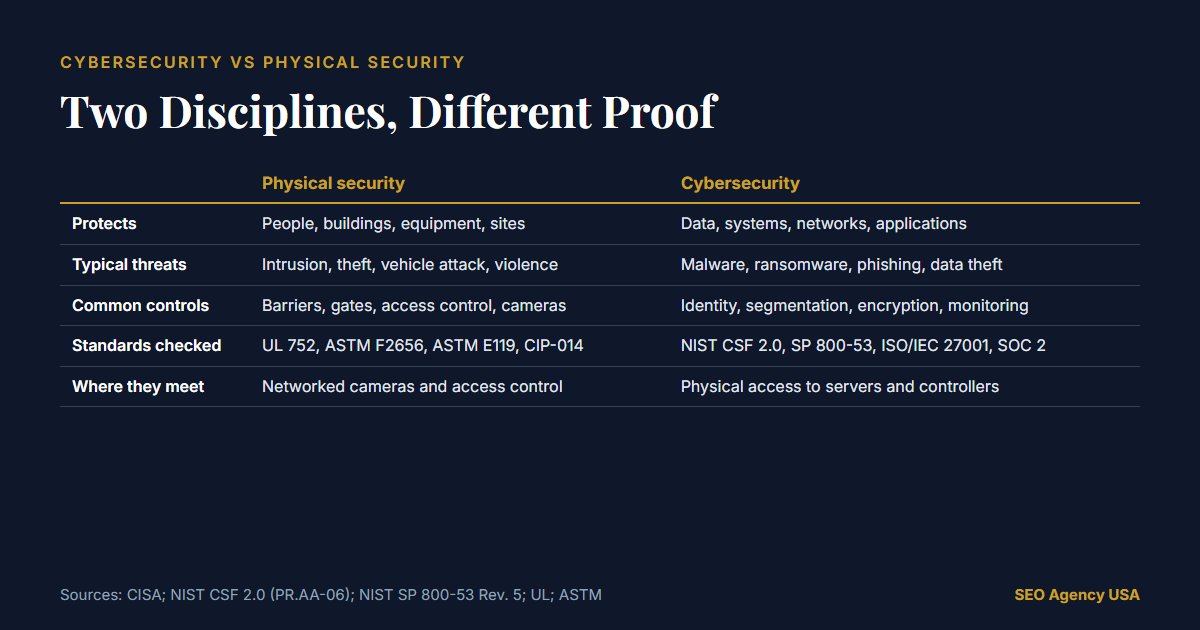
Cybersecurity protects information, systems, and networks from digital attack. Physical security protects people, buildings, equipment, and sites from physical harm, theft, and unauthorized entry. The two used to sit in separate departments with separate budgets. Today a camera, a card reader, or a substation controller is both a physical device and a network device, so the line between cybersecurity vs physical security is thinner than it was.
This guide explains what each discipline covers, the standards buyers check for each, where they overlap, and what the difference means for companies that sell security.
Key takeaways
- Different assets, different threats. Cybersecurity defends data and systems; physical security defends people, places, and things.
- Different standards. Cyber buyers check frameworks such as NIST CSF 2.0 and SOC 2. Physical security buyers check test standards such as UL 752, ASTM F2656, and ASTM E119.
- Physical security is part of cybersecurity. Locking the server room is a security control in every major framework.
- The two now meet at connected devices. CISA recommends treating cyber and physical security as one strategy.
- Security companies should market them separately and link them. The buyers, vocabulary, and proof differ.
What Is Physical Security?
Physical security is the protection of people, property, and assets from physical threats: unauthorized entry, theft, vandalism, violence, vehicle attacks, and damage from fire or other hazards. CISA's physical security work covers threats such as active shooters, bombings, vehicle ramming, drones, and insider threats (CISA).
In practice, physical security is built from layers: perimeter fence and barriers, gates and bollards, hardened walls and doors, lighting, access control, video surveillance, intrusion detection, and the people and procedures that respond to alarms. Each layer either deters, detects, delays, or supports a response.
What Is Cybersecurity?
Cybersecurity is the protection of information systems, networks, and data from unauthorized access, disruption, and theft. The NIST Cybersecurity Framework 2.0, released in February 2024, organizes the work into six functions: Govern, Identify, Protect, Detect, Respond, and Recover.
Cyber controls include identity and access management, network segmentation, encryption, endpoint protection, monitoring, vulnerability management, backups, and incident response.
Cybersecurity vs Physical Security: The Key Differences
| Physical security | Cybersecurity | |
|---|---|---|
| Protects | People, buildings, equipment, sites | Data, systems, networks, applications |
| Typical threats | Intrusion, theft, vandalism, vehicle attack, violence | Malware, ransomware, phishing, data theft, service disruption |
| Common controls | Barriers, walls, gates, access control, cameras, lighting, guards | Identity and access management, segmentation, encryption, monitoring |
| Standards buyers check | UL 752, ASTM F2656, ASTM E119, UL 294, NERC CIP-014 | NIST CSF 2.0, NIST SP 800-53, ISO/IEC 27001, SOC 2, NERC CIP-002 to CIP-013 |
| Typical buyer | Security director, facility or substation engineer, specifier, GC | CISO, security engineer, compliance lead, IT director |
| Who builds it | Manufacturers, integrators, engineers, general contractors | Software vendors, managed security providers, consultancies |
The table shows why the two are hard to sell with one message. A security director comparing crash-rated barriers wants an ASTM F2656 rating and a foundation detail. A CISO comparing detection tools wants architecture, integrations, and audit evidence.
What Is Physical Security in Cybersecurity?
Physical security is part of every major cybersecurity framework, because an attacker who can touch a server, a switch, or a controller can often bypass digital defenses.
- NIST SP 800-53, the federal control catalog, has a full Physical and Environmental Protection family that covers physical access, visitors, monitoring, and environmental protection for information systems (NIST).
- NIST CSF 2.0 includes subcategory PR.AA-06 in its Protect function: physical access to assets is managed, monitored, and enforced commensurate with risk (NIST CSF 2.0).
- NERC CIP-006 covers physical security of BES Cyber Systems for the bulk power system, while CIP-014 covers physical security of critical transmission stations and substations themselves.
So the server room lock, the data center mantrap, and the substation fence all count. In cyber terms they protect information systems; in physical security terms they protect a place.
Where Cyber and Physical Security Overlap
The overlap is growing because physical security systems are now networked systems. Cameras, access control panels, intercoms, and talk-down speakers sit on IP networks and run software that needs patching. A compromised camera can become a way into the network, and a compromised network can disable the cameras. Standards have followed: UL 2900-2-3 sets software cybersecurity requirements for network-connectable security and life safety systems such as access control and video (UL Solutions).
CISA's guide on cybersecurity and physical security convergence makes the case for treating the two as one strategy, so that the teams protecting a site share information and plan together. In critical infrastructure, the same logic shows up in NERC's standards, where cyber and physical requirements sit side by side, and in grid security events such as GridSecCon, which NERC and the E-ISAC host each year on both cyber and physical security of the grid.
For buyers, convergence means more questions in each purchase. A physical security buyer may now ask how a camera is secured, and a cybersecurity buyer may ask how a data center controls physical access to its racks.
Layered Security in Both Disciplines
Both fields rely on layers so that one failure does not expose the asset.
- Physical layers: perimeter, barriers, building shell, interior access control, the protected room or equipment, and response.
- Cyber layers: identity, network, endpoint, application, data, and monitoring and response.
At a substation or data center, the layers interlock: the fence and cameras protect the control building, and the network controls protect the systems inside it. Owners who plan both together close gaps that neither team sees alone.
What the Difference Means for Security Companies
For companies that sell security, the practical lesson is to market cyber and physical work separately, then connect them.
- Separate pages and programs. A physical security manufacturer and a managed detection provider are found by different buyers with different searches.
- Different proof. Physical security buyers check test reports, ratings, stamped designs, and project history by asset type. Cyber buyers check documentation, framework mapping, audit reports, and references.
- Shared pages for convergence. Firms that do both should explain how their cyber and physical work fits together at a site, and link those pages from each side.
- Accuracy everywhere. A wrong UL 752 level or a wrong NIST control reference costs a security company credibility with exactly the buyers it wants.
Our physical security marketing program serves manufacturers, integrators, engineers, and contractors, and our cybersecurity SEO services serve security vendors and managed security providers. For the marketing side of cyber, see our cybersecurity marketing strategy guide.
The Bottom Line
- Cybersecurity protects data and systems; physical security protects people, places, and equipment.
- Each has its own standards: frameworks and audits for cyber, test standards and ratings for physical.
- Physical security is part of cybersecurity, and networked devices tie the two together.
- CISA recommends treating them as one strategy.
- Security companies should market each to its own buyers and connect the two where they meet.
To see how buyers and AI assistants describe your security company, talk to our team.
About the Author
Jason Langella is the Founder and Chairman of SEO Agency USA. He was named the 2025 Associate Member of the Year by the Florida Municipal Electric Association (FMEA) and has taken part in more than 100 energy and utility industry events, where owners, engineers, and contractors meet.
Frequently Asked Questions
What is the difference between cybersecurity and physical security?
Cybersecurity protects information, systems, and networks from digital attacks such as malware, phishing, and data theft. Physical security protects people, buildings, equipment, and sites from physical threats such as intrusion, theft, vehicle attacks, and violence. They use different controls and standards, and they overlap at networked devices such as cameras and access control.
What is physical security in cybersecurity?
It is the protection of the physical side of information systems: server rooms, data centers, network equipment, and control systems. Frameworks such as NIST SP 800-53 include a Physical and Environmental Protection control family, and NIST CSF 2.0 covers physical access to assets in subcategory PR.AA-06.
Is physical security part of cybersecurity?
Physical security is part of every major cybersecurity framework, because physical access to equipment can defeat digital controls. Physical security as a field is broader, though: it also protects people, buildings, and sites that have nothing to do with information systems.
What are examples of physical security?
Perimeter fence, crash-rated gates and bollards, ballistic and forced-entry walls and doors, security lighting, access control with card readers, video surveillance, intrusion detection, talk-down systems, and the monitoring center and staff that respond to alarms.
What is security convergence?
Security convergence is the practice of managing cybersecurity and physical security as one strategy, with shared planning and information. CISA promotes it because physical security systems now run on networks and cyber systems depend on physical protection.