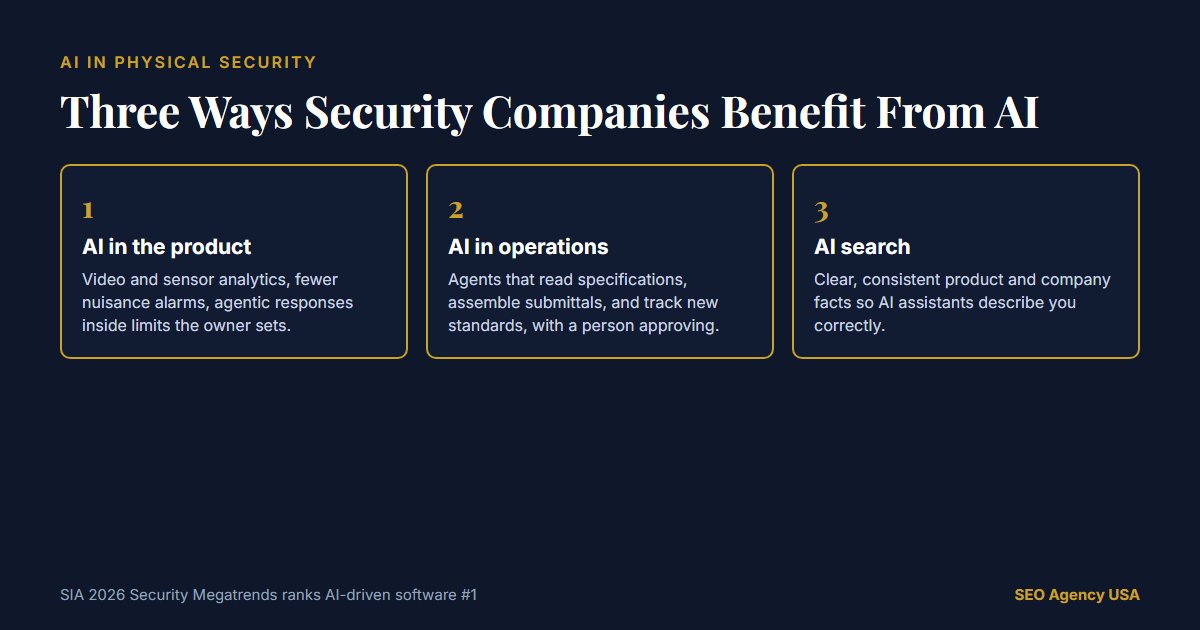
AI in physical security usually means video analytics that spot a person at a fence line or a vehicle in the wrong place. That is one side of it. For the companies that make, install, and build physical security, AI shows up in three places: inside the products they sell, inside the work they do every day, and inside the AI assistants their buyers use to research products and vendors.
This guide covers all three, with a focus on what manufacturers and integrators can do now and how to talk about AI in a way security buyers believe.
Key takeaways
- AI in physical security works in three places: the product, the company's operations, and AI search.
- The industry treats it as a top trend. The Security Industry Association's 2026 Security Megatrends put AI-driven software at number one.
- Agentic AI can draft, sort, and route, with a person approving. Specification reviews, submittals, and standards updates are good first uses.
- AI claims need the same proof as ratings. Say what the analytics detect, how they were tested, and how privacy is handled.
- Buyers ask AI assistants about you. Clear, consistent product and company facts shape the answers.
Why AI in Physical Security Matters Now
The Security Industry Association's 2026 Security Megatrends list put "Software Eats the World. Will AI Eat Software?" in the top spot (SIA), and SIA has published research on artificial intelligence in physical security for its members. Buyers see AI in every product announcement and want to know what is real. That creates an opening for companies that explain their AI plainly and a risk for those that overstate it.
1. AI in the Product
For manufacturers, AI most often appears in video and sensor analytics: detecting people, vehicles, loitering, or crossings at a perimeter, reducing nuisance alarms, and helping operators search recorded video. Other uses include access control that flags unusual patterns and talk-down systems that trigger a warning after a detection.
Agentic AI for physical security goes a step further: software that can take a defined action, such as opening an incident, calling up the right cameras, or drafting an alert for an operator, inside limits the owner sets. Security buyers will want to know exactly where those limits are and when a person takes over.
How to market AI features buyers trust
Security buyers treat AI claims the way they treat ballistic ratings: show the evidence.
- Say what it detects and what it does not. Name the objects, events, and conditions, and the environments where accuracy drops, such as heavy rain or low light.
- Explain how it was tested. Describe the test conditions in plain terms, and offer customers a way to evaluate it on their own site.
- Describe the human role. Who reviews an alert, who can override an action, and what is logged.
- Address privacy directly. Facial recognition and other biometrics carry legal and reputational risk. In December 2023, the FTC announced a proposed order that would ban Rite Aid from using facial recognition for surveillance for five years after finding it had deployed the technology without reasonable safeguards (FTC). Illinois' Biometric Information Privacy Act requires notice and written consent before collecting biometric identifiers such as face geometry (Illinois General Assembly). Buyers will ask how your product handles these rules.
- Use a recognized framework. NIST's AI Risk Management Framework, released in January 2023, organizes AI risk work into four functions: Govern, Map, Measure, and Manage (NIST). Describing your approach in those terms gives buyers a familiar reference.
- Remember the network. AI-enabled cameras and controllers are network devices. UL 2900-2-3 covers software cybersecurity for security and life safety systems such as access control and video (UL Solutions), and buyers with cyber teams will ask about it. Our guide to cybersecurity vs physical security covers where the two disciplines meet.
2. AI in Operations
The second benefit is less visible and often faster to deliver: using AI agents for the paperwork that slows every bid and project. Good first uses for physical security companies include:
| Workflow | What the agent does | Where a person decides |
|---|---|---|
| Specification and bid watch | Reads new specifications and bid notices, finds named products, ratings, and or-equal clauses, and drafts a bid or no-bid summary | The sales or estimating lead decides whether to pursue |
| Submittal assembly | Pulls the test reports, data sheets, and details that match the specified ratings and drafts the compliance matrix | The project manager or engineer reviews before submission |
| Standards and rule watch | Tracks new editions and notices from UL, ASTM, NERC, and FERC and matches them to affected products and projects | The engineering or compliance lead decides what changes |
| Lead routing | Sorts inbound requests by product, project stage, and territory, and drafts the first reply with technical context | A salesperson approves every reply |
Each of these runs on systems the company already uses, such as its CRM, document library, and project tools, and stops for a person before anything leaves the company. Our team builds these as AI agent development and AI workflow automation projects.
3. AI Search: How Buyers Find You
The third benefit is about visibility. Specifiers, owners, and integrators can now ask an AI assistant which barriers meet a crash rating, which panels meet a UL 752 designation, or which integrators serve a region. The answer draws on what is published about each company.
To be described correctly:
- Publish product names, ratings, standards, and editions in plain text, not only in PDFs
- Keep company facts consistent across your website, business profiles, distributor listings, and directories
- Use structured data for products, the organization, and service areas
- Answer the questions buyers ask on your own pages, in plain language
- Check what AI assistants say about your company and fix the gaps you find
Google says there are no additional requirements to appear in AI Overviews or AI Mode beyond normal SEO best practice (Google Search Central), so the same work improves both search rankings and AI answers. Our AI visibility and GEO methodology covers how we measure it.
Where to Start
- Pick one operational workflow with a clear owner, such as specification watch or submittals, and pilot it.
- Audit your AI product claims against the evidence you can show, and rewrite anything a careful buyer would challenge.
- Fix your public facts so AI assistants and search engines describe your products and ratings correctly.
- Train your team on where AI helps and where a person must decide.
The Bottom Line
- AI in physical security benefits manufacturers and integrators in three places: products, operations, and AI search.
- Market AI features with the same evidence you use for ratings, and address privacy and cybersecurity directly.
- Agentic AI is most useful today for drafting, sorting, and routing work, with a person approving.
- Clear, consistent public facts shape how AI assistants describe your company.
For the bigger picture, see our physical security marketing program and our guide to lead generation for security companies. To talk through where AI fits in your company, contact our team.
About the Author
Jason Langella is the Founder and Chairman of SEO Agency USA. He was named the 2025 Associate Member of the Year by the Florida Municipal Electric Association (FMEA) and has taken part in more than 100 energy and utility industry events, where owners, engineers, and contractors meet.
Frequently Asked Questions
How is AI used in physical security?
AI is used in video and sensor analytics to detect people, vehicles, and unusual activity, to reduce nuisance alarms, to search recorded video, and to trigger responses such as talk-down warnings. Security companies also use AI agents for specification reviews, submittals, and lead routing.
What is agentic AI for physical security?
Agentic AI is software that can take defined actions on its own, such as opening an incident, calling up cameras, or drafting an alert, within limits the owner sets. In physical security, the key questions are where those limits are and when a person takes over.
How can physical security companies benefit from AI?
Manufacturers and integrators benefit in three ways: AI features in their products, AI agents that handle specification, submittal, and standards paperwork with a person approving, and better visibility when buyers ask AI assistants about products and vendors.
What are the risks of AI in physical security?
The main risks are overstated accuracy claims, privacy and biometric law violations, and cybersecurity weaknesses in networked devices. Clear testing evidence, written privacy practices, and attention to standards such as UL 2900-2-3 reduce them.
How should security companies market AI products?
With evidence. State what the AI detects and what it does not, how it was tested, where a person stays in control, and how privacy and cybersecurity are handled. Security buyers trust specifics and distrust claims they cannot check.